

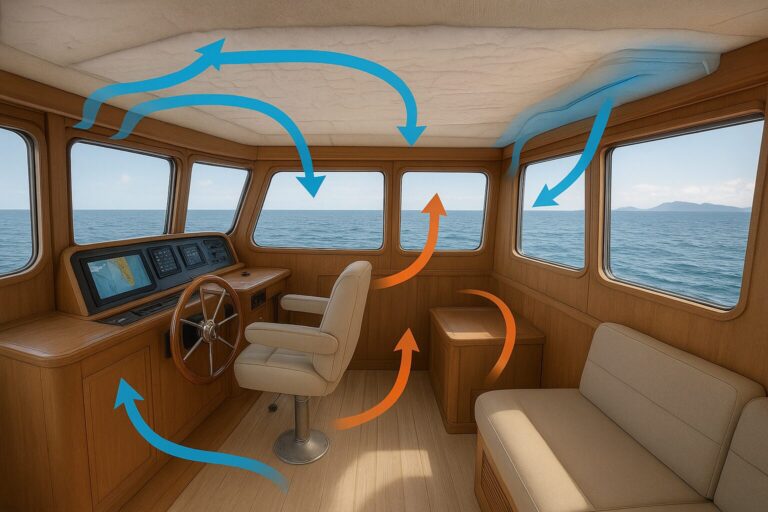
Thermal comfort in an enclosed pilothouse rarely comes down to a single failing material. When a wheelhouse feels clammy, drafty, or stifling, owners often look for an immediate fix—adding an electric heater, gluing insulation behind a panel, or swapping out a fan. Yet treating temperature without addressing air exchange usually trades one problem for another. Trapping warm air inside an enclosed bridge without managing moisture leads to dripping overheads, while opening a vent to clear fog can chill the watchstander and spike heating demands.
Achieving everyday comfort requires viewing thermal barriers, fresh-air delivery, and moisture extraction as an integrated system. Before commissioning yard work or tearing into joinery, you need to understand how these elements interact under underway and anchor conditions.
Diagnose the Cabin Environment Before Changing Materials
Effective thermal management begins with accurate diagnosis rather than immediate material selection. Symptoms that feel identical to an occupant—such as a persistent chill or damp cushions—often stem from entirely different physical mechanisms.
Start by keeping a log of when discomfort occurs. Note the differences between running at cruising speed, sitting on a mooring, or tied to shore power:
- Cold surfaces and drafts: Record where you feel cold and whether moving air enters around doors, windows or openings. A specialist can distinguish air leakage from cold-surface effects.
- Leaks and condensation: Note when and where moisture appears, including rain, spray, cooking and overnight occupancy; shoulder-season condensation is one possibility to investigate. These clues help an investigation but do not by themselves establish the cause.
- Humidity and odors: Record humidity if practical and describe lingering odors, without assuming every symptom has the same ventilation cause.
Covering a leaking frame before resolving the cause can hide moisture and make inspection harder. Diagnose the source before committing to a structural intervention.
The Physical Limits of Thermal and Acoustic Barriers
Insulation does not produce heat or remove moisture; it merely slows the rate of conductive and radiant heat transfer through the pilothouse envelope. In cold conditions, suitable insulation can help keep the interior face of a treated surface warmer.
As established in foundational principles for moisture control, condensation forms whenever an interior surface temperature drops below the dew point of the cabin air. By warming the interior face of an exposed surface, insulation reduces the physical opportunity for airborne vapor to liquefy against cabin linings. However, insulation alone cannot prevent condensation if interior humidity remains unchecked.
It is also vital to distinguish thermal control from sound dampening and airtightness. These three functions require different material properties:
- Thermal treatment: Slows heat transfer through treated surfaces.
- Acoustic treatment: Addresses sound transmission or absorption; it is not interchangeable with thermal insulation.
- Air sealing: Addresses drafts and leakage paths.
Material choice and installation need to preserve drying paths, access and the vessel’s appropriate construction requirements. Ask a marine specialist to assess the assembly rather than filling hidden cavities indiscriminately.
Circulation, Ventilation, and Dehumidification Serve Distinct Roles
Air management in a pilothouse involves three separate tasks: moving air, replacing air, and drying air. Conflating these three actions leads to poor climate control and wasted battery capacity.
- Circulation: Moves existing cabin air and can reduce temperature differences.
- Ventilation: Exchanges indoor and outdoor air; moisture effects depend on outside conditions.
- Dehumidification: Removes moisture using a suitable device or cooling system, with power and drainage requirements.
Circulation Evens Out Temperature Gradients
Fans move air that is already inside the vessel. In a tall pilothouse, warm air naturally stratifies near the ceiling while cold air settles at the helm sole. Circulation fans can redistribute warmth and support airflow around glazing, but they do not themselves remove water vapor from the occupied space.
Ventilation Introduces Outside Air
Ventilation physically swaps stale interior air for outdoor air using cowl vents, opening ports, sliding doors, or dedicated low-profile extraction blowers. Its success depends entirely on external ambient conditions:
- Cool, dry conditions: Outside-air exchange may reduce indoor moisture when the air is warmed.
- Warm, humid conditions: More outside air can add moisture, so ventilation alone may not solve the problem.
Dehumidification Controls the Dew Point
A suitable dehumidifier or cooling system can remove moisture, provided its capacity, power supply, drainage and operating conditions match the installation. Ask how the chosen equipment works in the temperatures expected aboard.
Balancing these systems can help address pilothouse heat buildup when large expanses of helm glass sit sealed under high solar loads without adequate air movement or extraction.
Assessing the Helm Station Layout and Operational Demands
Upgrading the thermal and airflow characteristics of a pilothouse requires working around sensitive electronics, structural stiffeners, and strict maritime safety obligations. Modifications must never compromise navigation visibility or physical equipment access.
Visibility and Watchkeeping Compliance
Rule 5 through Rule 7 of the USCG navigation rules require every vessel to maintain a proper lookout by sight and hearing at all times, travel at a safe speed, and use all available means to determine if risk of collision exists.
Thermal alterations directly impact these requirements:
- Dark window films intended to reject heat can degrade night vision and obscure unlit navigation aids.
- Noisy inline blowers or poorly mounted defroster fans can drown out sound signals or the whistle of approaching traffic.
- Plan demisting and duct placement so you can maintain the view needed for watchkeeping; electronic aids do not replace a proper lookout.
Equipment Access and Service Corridors
Pilothouses concentrate heavy electrical, monitoring, and navigation networks into compact console spaces. Our North Pacific 49′ Pilothouse equipment includes Garmin chartplotters, radar, autopilot and VHF radios, an AGM battery bank and a Victron inverter/charger, with lithium battery options available.
We engineer equipment access using dedicated hatches, removable headliners, and accessible wiring chases. When adding insulation or running ventilation ducting, never fill wiring chases with expanding foam or glue thermal liners over removable panels. Technicians must be able to pull new NMEA runs, access helm steering pumps, and service electronics without cutting through insulation blankets.
Exhaust Pathways and Air Quality
When planning forced-air diesel heating or installing extraction blowers, adhere to strict carbon monoxide precautions. Low-pressure zones created along the leeward side or aft bulkhead of a moving pilothouse can pull engine or generator exhaust back inside through cracked doors or poorly sited vent cowls—a phenomenon known as the station-wagon effect. Ventilation alone is never a substitute for proper exhaust design, intact manifold gaskets, and operational marine-grade carbon monoxide detectors selected and installed according to their instructions.
Building a Balanced Improvement Brief for a Specialist
If your pilothouse requires thermal or airflow remediation, approach a marine shipwright or systems technician with clear, documented operational profiles rather than asking for generic insulation installations.
Prepare a brief detailing how you actually use the boat:
- Operating geography and season: Note typical water temperatures and outside air ranges. An enclosed helm running the Inside Passage to Alaska faces prolonged surface-cooling and continuous hull conduction, whereas a vessel cruising the Intracoastal Waterway faces heavy solar radiation and ambient humidity.
- Occupancy profiles: State how many people live aboard underway versus at dock. Breathing, cooking, showering and wet gear contribute moisture; the ventilation requirement depends on the actual installation and conditions.
- Power parameters: Define your power limits at rest. Note whether improvements must function strictly on house battery reserves at anchor, or if the boat regularly operates a generator or plugs into shore power. If you run an inverter-supported battery bank, establish the surplus amp-hours available for continuous ventilation fans or heating blowers.
- Specific symptom logs: Present your notes detailing where droplets gather, which window mullions drop below ambient temperature, and where exterior drafts enter the helm area.
A marine professional can then assess whether your pilothouse needs improved window thermal breaks, redirected heating ducts, passive vent baffles, or dedicated mechanical dehumidification.
We welcome the opportunity to discuss your cruising plans with us and consider the equipment choices appropriate to your intended seasons and routines.