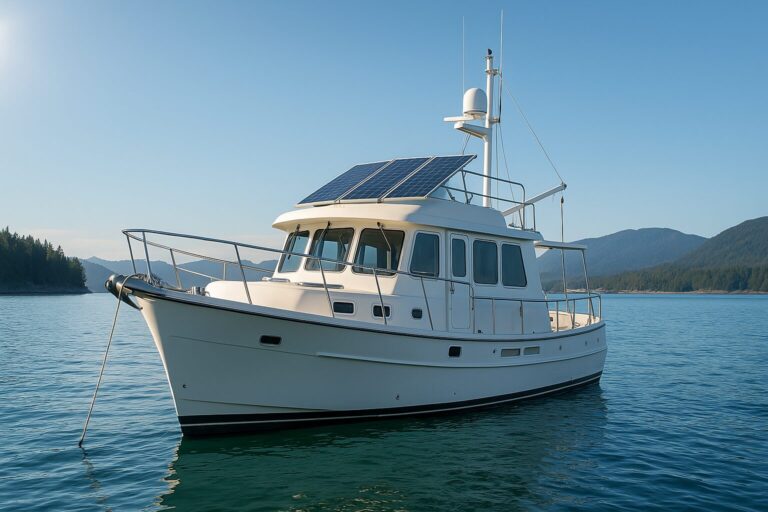
Solar power can be a useful part of a cruising yacht’s charging system. Whether it meaningfully reduces other charging needs depends on the boat’s electrical demand, the installed array and the conditions in which you use it. Start with that comparison rather than a promise of all-electric independence.
To determine whether solar makes practical sense for your vessel, you must balance your actual daily electrical consumption against a qualified installer’s seasonal harvest estimate. Understanding the mechanical, physical, and environmental realities of marine solar ensures you invest in a system that genuinely supports how you live aboard.
Auditing Daily Energy Demand Before Sizing an Array
Every sound electrical upgrade starts with a consumption audit rather than an equipment catalog. You must know how many watt-hours your boat uses in a typical 24-hour cycle before you can judge whether a solar array will make a meaningful dent in your energy deficit.
Electrical equipment draws power over time, measured in watt-hours. To calculate this, multiply an appliance’s operating wattage by the hours it runs per day. Consider this simple, hypothetical arithmetic:
- A marine refrigeration compressor drawing 60 watts that runs for a cumulative 10 hours throughout the day consumes 600 watt-hours (60 watts × 10 hours).
- A network of cabin LED lights drawing 25 watts running for 4 hours consumes 100 watt-hours (25 watts × 4 hours).
- In this hypothetical scenario, just these two loads require 700 watt-hours every 24 hours.
When you tally your continuous DC loads—navigation displays, autopilot, freshwater pressure pumps, communication gear, and inverter standby draw—the total watt-hour requirement grows quickly. Comparing this final daily total against an installer’s realistic generation forecast helps estimate the portion of demand solar may supply and the charging that will still be needed.
Solar Yield Realities: Weather, Orientation, and Moving Shade
On-paper panel ratings represent laboratory conditions that an ocean-going yacht rarely encounters. Several distinct variables routinely drag real-world harvest below theoretical maximums: insufficient solar supply during short winter days, persistent heavy cloud cover, unfavorable panel orientation to the sun, and continuous high DC loads that consume power faster than panels can replace it.
Marine shading presents an even harsher operational penalty. Shadows on a boat can change as its heading and the sun’s position change. A mast, radar arch, satcom dome, or boom will cast a moving shadow across your panels as the boat swings at anchor. In a typical marine array, shading a single corner of one panel can dramatically reduce the output of an entire string of cells.
When evaluating potential generation, marine professionals often reference modeling tools like the National Renewable Energy Laboratory’s PVWatts calculator. PVWatts allows users to configure system losses, tilt angles, and shading percentages, but it is fundamentally built around stationary, grid-connected structures. It provides valuable high-level context on regional solar energy availability across different seasons, but it is not a dynamic marine yield prediction tool. It cannot account for a pitching deck, shifting anchor headings, or localized superstructure shadows, and it is never a substitute for a physical shade study conducted on your specific vessel.
Deck Space, Balance of Systems, and Installation Safety
Panels require suitable mounting space, which is already at a premium on a well-equipped long-range yacht. Hardtops and cabin roofs must comfortably share space with radar masts, satellite antennas, searchlights, and tender cranes. Any usable mounting area must preserve safe crew access for handling lines, servicing deck hardware, and washing down surfaces, without creating blind spots from the helm.
Beneath the deck, the harvest must be managed safely. Raw power from the array passes through charge controllers configured to match your specific battery chemistry before reaching your house battery banks.
Marine electrical systems involve serious safety concerns:
- Improperly managed DC circuits present severe electric shock hazards and fire risks.
- Battery and charging equipment have chemistry-specific hazards and compatibility requirements.
- Charging equipment requires a clean, heatproof environment with sufficient ventilation to dissipate operational heat and prevent component failure.
- Equipment must be configured strictly in accordance with manufacturer instructions and battery chemistry specifications.
Because of these life-safety considerations, system architecture must be handled by qualified marine electricians. Discuss protection, access and inspection requirements with the installer so that electrical system maintenance remains practical after the addition.
Defining Solar’s Role in a Wider Charging Strategy
Solar can work alongside alternators, shore power and an onboard generator. The useful question is how much of your demand it can supply during the conditions you expect, including cloudy periods. High-power appliances deserve separate attention because their consumption can change the budget substantially.
A suitably designed array may offset some daytime refrigeration, lighting and electronics demand, or help maintain batteries during time without shore power. That contribution must be checked against actual loads, battery requirements and seasonal generation; monitoring and essential equipment should retain an adequate charging plan.
Extended stays at anchor may give solar a useful role in your routine. Daily travel between marinas may make other charging sources more available. Compare both situations with your own energy budget, usable installation space and estimated costs before deciding what scale of system is worthwhile.
When you are ready to evaluate your cruising priorities against the specific layout and electrical demands of a particular boat, talk with us about how your time on the water shapes the right balance of onboard systems.
Sources
- PVWatts calculator and assumptions
- Victron SmartSolar troubleshooting
- Victron SmartSolar safety precautions