
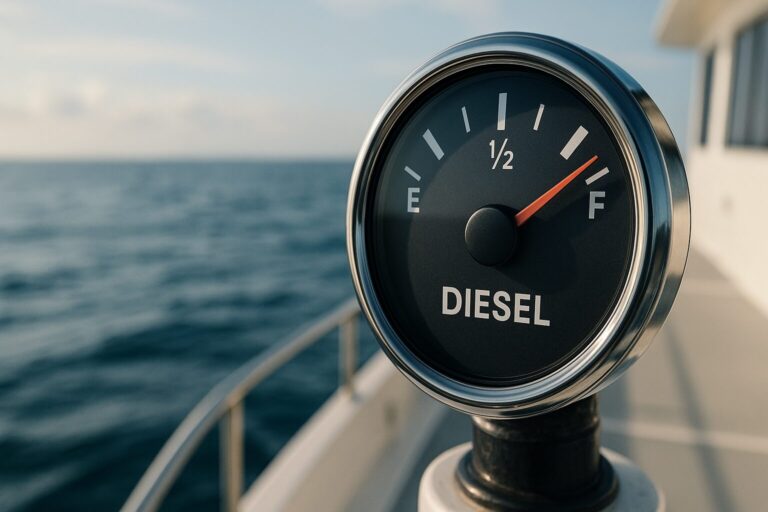
Large fuel tanks are a hallmark of trawler yachts, setting them apart from faster, more speed-focused vessels. This feature isn’t just about carrying more diesel, it’s central to how trawlers are built and used. Unlike day cruisers or performance boats that rely on frequent marina stops, trawlers are designed for endurance and range. Their hulls, propulsion systems, and navigation equipment are all tailored toward slow, steady, and far-reaching travel. As such, having the ability to store ample fuel enables the kind of extended cruising that defines the trawler lifestyle. Whether navigating through remote fjords or making an offshore passage, the assurance that you can go hundreds or even thousands of miles without needing to refuel is part of what makes trawler cruising so distinct.
The importance of large tank capacity becomes even more evident when you consider the environments trawlers are often used in. Remote island chains, long stretches of undeveloped coastline, and weather-dependent travel schedules make fuel access unpredictable. Having large tanks onboard allows captains to bypass ports entirely when needed or wait out foul weather in a quiet anchorage without worrying about fuel consumption. It adds layers of flexibility to every decision, from route planning to time spent in any one location. For many trawler owners, this self-reliance is not just a benefit, it’s the very reason they chose this type of vessel in the first place.
Extended Range and Freedom
Range is everything for long-distance cruisers, and fuel is what defines that range. Trawlers are optimized for fuel efficiency, cruising at speeds typically between 7 and 10 knots. These lower speeds might seem modest compared to performance boats, but they enable extraordinary travel distances per gallon of diesel. With fuel tanks commonly holding between several hundred to well over a thousand gallons, a trawler can cover vast stretches of ocean without needing to pull into port. This is not just a convenience—it’s often a necessity. In parts of the world where marinas are few and far between, or where geopolitical situations limit access, the ability to go the distance becomes a practical safeguard.
More fuel onboard doesn’t just equate to longer trips; it means more control over how those trips unfold. Captains aren’t forced to stick to routes that follow fuel availability. Instead, they can prioritize calmer seas, more scenic paths, or even personal preferences. If a beautiful anchorage tempts an extended stay, there’s no looming pressure to move on for resupply. This kind of independence turns the journey into an open-ended experience rather than a series of fuel-driven check-ins. In that sense, large tanks don’t just power the boat—they power the freedom that defines trawler cruising.
Fuel Efficiency and Engine Health
Trawlers are engineered to be workhorses, not sprinters. Their engines run best at a steady, low RPM for extended periods, a configuration that not only maximizes fuel efficiency but also enhances long-term engine health. Large fuel tanks support this mode of travel by allowing the engine to remain in its optimal operating range for days on end without interruption. Unlike performance boats that swing between idle and full throttle, trawlers can maintain a smooth, consistent rhythm that favors both economy and mechanical longevity. The result is less wear on the engine, fewer mechanical failures, and a generally quieter, more relaxing onboard experience.
This steady operating condition also benefits auxiliary systems that depend on predictable engine behavior. Transmission components, propeller shafts, and cooling systems all fare better when subjected to consistent loads rather than constant acceleration and deceleration. Over time, this reduces the strain on parts and lowers the likelihood of breakdowns or expensive repairs. For owners, this translates to more than just cost savings—it means reliability. And in a trawler, where you might be days from the nearest mechanic, that reliability isn’t optional; it’s foundational.
Safety and Peace of Mind
Carrying a generous amount of fuel isn’t just about ambition—it’s about preparation. Open water voyages and remote cruising routes often introduce variables that no weather forecast or chart can predict. Sudden storms, unanticipated currents, or a need to alter course can dramatically increase fuel consumption. Without the buffer of large tanks, even a short delay could become a critical problem. Trawlers with extensive fuel reserves are better equipped to handle these unknowns, transforming what could be a high-risk situation into a manageable adjustment. Having that cushion means decisions can be made for safety, not just efficiency.
Beyond propulsion, many critical onboard systems are powered by the same fuel source. Heating systems, onboard generators, watermakers, and refrigeration units all require a steady diesel supply. When your boat doubles as your home, being able to run these systems without rationing fuel becomes vital for comfort and even survival. Especially in colder climates or while anchoring for extended periods, the peace of mind that comes with knowing your basic needs are covered can’t be overstated. It’s not just about getting from one point to another—it’s about living well along the way.
Balancing Weight and Design
It’s no small feat to incorporate large fuel storage into a vessel without sacrificing stability or performance. Designers and naval architects must carefully calculate where and how to place fuel tanks so that they support not hinder the vessel’s performance at sea. On trawlers, tanks are usually located low in the hull and near the centerline. This positioning helps maintain balance, keeps the center of gravity down, and minimizes roll while under way. In some cases, a full tank can actually enhance the vessel’s motion in rough seas by dampening quick movements and creating a smoother ride.
The integration of fuel tanks also plays a structural role in many trawler designs. Instead of being afterthoughts, tanks are often built into the frame of the vessel itself, serving as part of the internal support system. This avoids unnecessary bulking and keeps the vessel’s layout efficient. When weight is distributed thoughtfully, the trawler remains trim, efficient, and comfortable even at full load. This design harmony is what allows a vessel to perform reliably whether it’s near empty or running at maximum capacity. Ultimately, it reflects the philosophy behind trawler design: practical, robust, and built for the long haul.
Why Choose North Pacific Yachts Services
We turn your cruising dreams into reality by developing bespoke trawler and pilothouse yachts built for comfort, safety, and performance. From the initial hull design to the final varnish, our experienced naval architects and craftsmen collaborate with you every step of the way, integrating fuel-efficient engines, ergonomic deck layouts, and beautifully appointed living spaces. With industry-leading warranties and personalized support, we make sure your new yacht feels like home the moment you step on deck. Reach out to us by email at info@northpacificyachts.com for personalized responses to all your inquiries. If you’d prefer a conversation, we invite you to give us a call at 1-877-564-9989.