
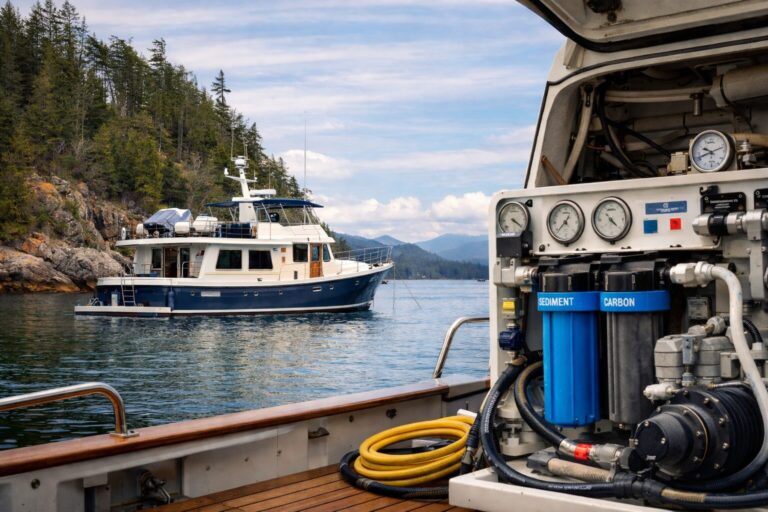
A watermaker, also called a desalination system, turns seawater into fresh water you can drink, cook with, and use for daily life onboard. If you have ever looked at the price tag, the install space it takes, and the maintenance it needs, you have probably wondered if it is truly worth it for a trawler. The honest answer is this: many trawler owners do not need a watermaker all the time, but some owners absolutely do. The difference usually comes down to how you cruise, how long you stay away from marinas, and how much fresh water your crew actually uses. If you run a custom trawler or pilothouse yacht in the North Pacific, planning matters even more because your cruising grounds can be remote, weather can stretch passages, and dock services are not always close or convenient.
What a Watermaker Really Does and What It Does Not
Most modern watermakers on trawlers use reverse osmosis. A high pressure pump pushes seawater through special membranes. Salt and impurities are rejected, and fresh water goes into your tanks. A good system makes safe, clear water when it is installed correctly, operated correctly, and maintained correctly. But a watermaker is not a magic solution for every water issue onboard. It does not replace good tank hygiene. Your tanks still need to be kept clean, and you still need to protect water quality from contamination in hoses and fittings. It also does not like bad intake water. If you are anchored in a silty bay, near heavy runoff, or in a harbor with fuel sheen and debris, you may not want to run it. The system can clog filters quickly, and the membranes can foul faster.
Another key point is power. Watermakers need energy, and on a trawler that often means running a generator, pulling from an inverter and battery bank, or timing water production while you are already generating power for other loads. The more water you want each day, the more you have to plan around power. So when you think about a watermaker, think of it as a tool that gives you independence, but only if you are comfortable operating a small system that has pumps, filters, membranes, and a routine.
The Real Question: How Much Water Do You Actually Use
The biggest mistake we see is choosing a watermaker before understanding daily water demand. Your tanks may feel large, but a crew can burn through water surprisingly fast.
Here is a realistic way to estimate:
- Drinking and cooking: about 1 to 2 gallons per person per day.
- Quick freshwater rinse for dishes: 2 to 4 gallons per day for a couple, more for families.
- Showers: a navy shower can be 2 to 4 gallons, a normal shower can be 6 to 10 gallons.
- Laundry: a compact washer can use 10 to 20 gallons per load depending on model and settings.
- Deck washdowns and fish cleanup: can be low if you use seawater first, or high if you rely on freshwater.
For two people cruising with conservative habits, you might average 8 to 15 gallons per day. For a family with regular showers and laundry, it can easily be 25 to 50 gallons per day. Now compare that to your tank capacity. A lot of trawlers carry somewhere around 150 to 400 gallons, sometimes more on larger builds. If you have 250 gallons usable and you use 25 gallons a day, you have around 10 days on paper. In real life, you keep a reserve, you may lose some to sloshing and pickup limits, and you may face a longer gap between good fill opportunities. Suddenly your comfortable range becomes 5 to 7 days.
That is where watermakers start to make sense. If your trips regularly push beyond what your tanks can comfortably support, you will feel the benefit quickly. If you are mostly doing weekend trips, marina hopping, or short coastal legs with easy access to dock water, you may not. A simple test is this: if you already find yourself rationing water or changing plans to chase a hose bib, you are in watermaker territory.
When You Actually Need One: The North Pacific Cruising Reality
On a custom trawler or pilothouse yacht in the North Pacific, “need” usually shows up in a few clear scenarios.
1) You Anchor Out for Long Stretches
If your favorite cruising involves remote bays, island chains, and quiet coves where you might stay for a week or more, a watermaker can turn a short visit into a comfortable, extended stay. You can take normal showers, rinse dishes properly, and keep the boat clean without stressing over the tank gauge. This is especially valuable when the weather turns. If strong winds, swell, or fog keep you put for longer than planned, water independence reduces pressure to move on a schedule that does not match the conditions.
2) You Cruise Where Dock Water Is Limited or Questionable
In some areas, dock water can be unavailable, seasonal, or not something you want to drink without treatment. Even when it is available, you may have long waits, awkward docking, or limited hours. A watermaker lets you treat your boat like a self contained cabin. You can top up tanks whenever you have clean intake water and enough power, rather than timing your route around marinas.
3) You Carry More People or Stay Aboard Full Time
The more people aboard, the faster you burn water, and the faster you hit the “rationing zone.” If you often cruise with guests, kids, or crew, or you live aboard for weeks at a time, a watermaker moves from luxury to practical tool. This also applies if your comfort standards include regular showers, laundry, and galley routines that feel like home.
4) You Have Other Systems That Depend on Water
Some boats use freshwater for certain deck cleaning setups, some have water cooled gear that benefits from steady supply, and some owners prefer to have abundant water for rinsing salt off windows and rails. These are not essential, but they influence your day to day experience onboard.
5) Your Boat’s Layout and Build Support It Well
Need is not only about cruising style. It is also about the boat. If you have room for proper install, easy access to filters, and a power setup that can support it, the upgrade is much more likely to be used and appreciated. On a custom build, planning for a watermaker early makes it cleaner, safer, and easier to maintain.
If your boat has limited space, difficult access, or a marginal power setup, a watermaker might become something you avoid running, which defeats the purpose.
Choosing a Setup That Fits: Practical Sizing, Power, and Installation Notes
If you decide you are in the “need one” camp, the next question is what kind.
Output and Sizing
Watermakers are often rated in gallons per hour or liters per hour. A common sweet spot for trawlers is a unit that can comfortably cover your average daily use without running all day.
As a simple rule:
- Couples who cruise conservatively often do well with a smaller unit that can produce roughly 10 to 20 gallons per hour.
- Families, heavy shower use, and regular laundry often benefit from higher output or more run time flexibility.
Bigger is not always better. Larger systems can mean higher power draw and more plumbing complexity. The best system is the one you can run regularly without changing your whole routine.
Power Planning
On many trawlers, the most practical approach is running the watermaker while the generator is already on for charging, cooking, or other house loads. Some owners run it while underway if they prefer, as long as the intake stays clear and conditions are suitable.
If you are designing or upgrading a boat, think about:
- Generator capacity and typical run schedule.
- Battery bank size and inverter capability if you want shorter generator run time.
- Noise and vibration considerations since watermakers have pumps and can transmit sound if mounted poorly.
Water Quality and Pretreatment
The health of your membranes depends on the quality of seawater going in and the quality of filtration before the membranes.
Key habits include:
- Using good prefilters and changing them on schedule.
- Avoiding operation in dirty harbors, heavy algae blooms, or muddy anchorages.
- Flushing and pickling the system correctly if it will sit unused.
A watermaker is not hard to manage, but it is not a set and forget device. Owners who love their watermakers tend to be the ones who build a simple routine and stick to it.
Space and Service Access
This is where custom trawlers shine. The most common frustration we hear is not the watermaker itself, but trying to service it in a cramped corner.
Good installation should allow:
- Easy access to filters without contorting.
- Clear labeling of valves.
- A clean, protected sea water intake path.
- Thoughtful routing of brine discharge.
- A reliable place for spares and pickling supplies.
If you can reach it, you will maintain it. If you cannot reach it, it becomes a problem.
When You Do Not Need One and What to Do Instead
It is perfectly reasonable to skip a watermaker if your cruising patterns do not demand it. Here are common cases where it may not be worth it:
- You spend most nights in marinas or close to reliable dock water.
- Your trips are short and you rarely run low.
- You prefer minimal systems and low maintenance.
- Your power budget is tight and you avoid running the generator often.
- Your cruising waters are frequently silty or dirty where running a watermaker would be inconvenient.
If that sounds like you, you still have options to make freshwater life easier:
- Increase tank capacity if your boat design allows it.
- Add a dedicated drinking water filter and keep the rest for washing.
- Use seawater for first rinse on dishes and deck cleaning, then finish with freshwater.
- Install a cockpit shower and use quick rinse routines.
- Carry collapsible jugs for occasional extra capacity when you know you will anchor out.
These steps can add real comfort without the cost and complexity of a full desalination system.
The Bottom Line: A Watermaker Is Worth It When It Changes Your Cruising Freedom
You actually need a watermaker when it removes a real limitation from your cruising. If you keep altering routes to find water, cutting great anchor time short, or rationing so much that the trip feels smaller than it should, a watermaker can be one of the most meaningful upgrades you make. But if water is rarely a concern, or if you want the simplest possible trawler setup, you can skip it confidently and focus on smart tank management, filtration, and a few practical habits. On North Pacific style cruising, where distances and weather can stretch plans, the best decision is the one that supports your independence without adding stress. If a watermaker lets you stay longer, go farther, and enjoy life onboard more naturally, then it is not just another system. It is a tool that matches the way you actually use your trawler.
We turn your cruising dreams into reality by developing bespoke trawler and pilothouse yachts built for comfort, safety, and performance. From the initial hull design to the final varnish, our experienced naval architects and craftsmen collaborate with you every step of the way, integrating fuel-efficient engines, ergonomic deck layouts, and beautifully appointed living spaces. With industry-leading warranties and personalized support, we make sure your new yacht feels like home the moment you step on deck. Reach out to us by email at info@northpacificyachts.com for personalized responses to all your inquiries. If you’d prefer a conversation, we invite you to give us a call at 1-877-564-9989.
FAQs: Watermakers on Trawlers
1. Do I really need a watermaker on a trawler?
You usually need a watermaker if you anchor out for long periods, cruise in remote areas with limited dock water, or regularly run out of freshwater based on your tank size and daily usage. If you mostly stay near marinas and refill often, you may not need one.
2. How much freshwater does a typical trawler crew use per day?
A couple cruising conservatively may use around 8 to 15 gallons per day. A family or larger crew with regular showers and laundry can use 25 to 50 gallons per day or more. Your usage depends on shower habits, dishwashing, laundry, and how often you wash down the boat.
3. What size watermaker is best for a trawler?
The best size depends on your daily water needs and how long you want to run the system. Many trawler owners choose a unit that can cover daily use in a reasonable run window, often by producing enough water in a couple of hours rather than running all day. A properly sized system should match your cruising routine and power setup.
4. Can I run a watermaker while at anchor in the North Pacific?
Yes, many owners run watermakers at anchor, but you should avoid making water in dirty harbors, silty bays, or areas with fuel sheen, heavy runoff, or algae. Cleaner intake water helps protect filters and membranes and reduces maintenance.
5. What maintenance does a trawler watermaker require?
Most watermakers require regular prefilter changes, periodic membrane care, and proper flushing after use. If the system will sit unused for a while, it may need preservation steps (often called pickling) to protect the membranes. Consistent routine maintenance is the key to reliable performance.