
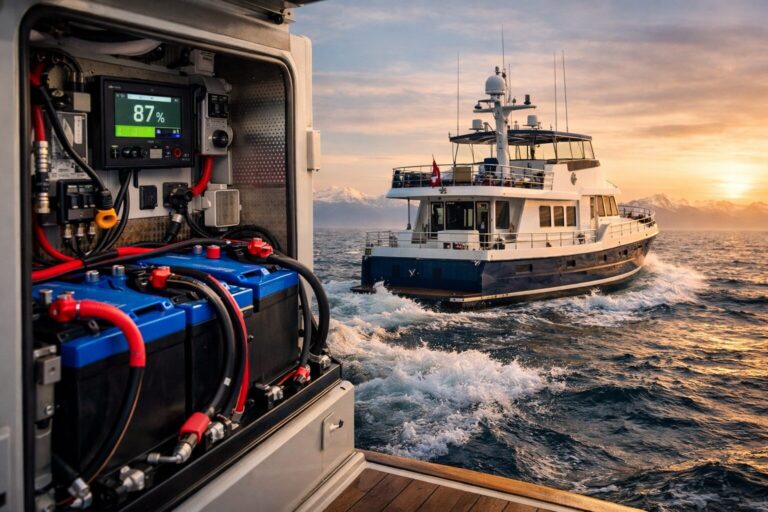
Battery banks play a critical role on long-range trawlers and pilothouse yachts, especially for owners planning extended cruising in the North Pacific. These waters demand reliability, self-sufficiency, and systems that work as expected when shore support is far away. Battery banks are often discussed in terms of capacity, usually measured in amp-hours or kilowatt-hours, but real-world performance rarely matches the numbers on paper.
Many owners assume that a larger battery bank automatically means longer autonomy. In reality, how batteries behave offshore depends on many factors, including discharge limits, charging methods, onboard loads, temperature, and system design. Understanding the difference between theoretical capacity and usable energy is essential when designing or selecting a long-range trawler meant for serious cruising. On modern trawlers, battery banks support navigation systems, lighting, refrigeration, communications, pumps, and increasingly, hotel loads such as induction cooking or climate control. The bank is not just a backup system anymore. It is the backbone of daily life onboard.
Capacity Numbers vs Usable Power at Sea
Battery manufacturers often list capacity under ideal laboratory conditions. These conditions rarely exist on a yacht operating in cold northern waters or during long overnight passages. A battery rated at 800 amp-hours does not mean you can safely use all 800 amp-hours without consequences. Lead-acid batteries, including AGM and gel types, typically allow only about 50 percent of their rated capacity to be used if you want a reasonable lifespan. That means an 800 amp-hour bank realistically provides about 400 amp-hours. Lithium batteries improve this figure significantly, often allowing 80 to 90 percent usable capacity, but even then, system limits and safety margins reduce what is practically available.
Voltage drop also affects usable power. As batteries discharge, voltage falls, which can cause sensitive electronics or inverters to shut down before the battery is technically empty. This is especially noticeable on older systems or poorly balanced banks. Another factor often overlooked is how quickly power is drawn. High loads such as bow thrusters, windlasses, or large inverters reduce effective capacity due to inefficiencies and heat losses. This means that heavy usage over short periods can drain a battery bank faster than expected, even if total energy consumption seems reasonable.
Real-World Loads on Long-Range Cruising Yachts
Long-range trawlers are designed for comfort as well as endurance. Real-world electrical loads are often higher than owners expect, especially during extended time away from marinas. Refrigeration runs continuously. Navigation electronics stay powered for safety. Autopilots, radar, AIS, and communication systems draw steady current. At anchor, lighting, entertainment systems, water pumps, and ventilation add to the load. In colder North Pacific climates, battery performance can also decline due to low temperatures. Batteries become less efficient, and charging takes longer. Heating systems, whether diesel-fired or electric circulation pumps, further increase electrical demand.
Another reality is human behavior. Power usage tends to increase over time. A short weekend trip may involve conservative energy habits, but during weeks or months aboard, comfort becomes a priority. This shift often exposes the gap between calculated capacity and actual daily consumption. Battery banks must be sized not just for average usage but for worst-case scenarios such as extended cloudy weather, long motoring days with high electronics use, or unexpected equipment failures that increase power draw.
Charging Systems and Their Limitations
Even a well-sized battery bank is only as effective as its charging system. On long-range trawlers, charging typically comes from a combination of engine alternators, generators, solar panels, and occasionally shore power when available. Engine alternators often appear powerful on paper but rarely deliver their maximum output for long periods. Heat buildup, belt limitations, and voltage regulation reduce sustained charging capacity. Generators provide reliable power but add fuel consumption, noise, and maintenance requirements. Solar energy is an excellent supplement, especially at anchor, but its output varies widely based on weather, sun angle, and panel placement. In northern latitudes, shorter days and frequent overcast conditions limit solar contribution during much of the year.
Charging inefficiencies also play a role. Energy lost as heat, imperfect charge acceptance, and system wiring losses all reduce how much power actually reaches the batteries. As batteries approach full charge, charging slows dramatically, meaning the last 20 percent of capacity can take as long as the first 60 percent to replenish. This reality often surprises owners who expect to fully recharge large battery banks with short engine runs or brief generator use.
Designing Battery Banks for Reality, Not Theory
The most successful long-range trawlers are designed around realistic energy expectations rather than ideal calculations. This starts with an honest assessment of daily power usage, including future upgrades or lifestyle changes. Oversizing battery banks without matching charging capability often leads to frustration rather than freedom. System balance is key. Battery capacity, charging sources, inverter size, and wiring must work together as a unified system. Redundancy also matters. Separate banks for engine starting, house loads, and critical systems improve safety and reliability on extended voyages. Monitoring systems play an important role as well. Accurate battery monitors provide real-time insight into state of charge, consumption trends, and charging performance. This information allows owners to adjust habits before problems arise.
Material selection matters too. Lithium systems offer higher usable capacity and faster charging, but they require advanced management systems and careful installation. Traditional batteries remain viable when properly sized and maintained, especially for owners who prefer proven technology and simpler serviceability in remote regions. Ultimately, the goal is not maximum capacity but predictable performance. A battery bank that reliably supports daily needs, charges efficiently, and maintains long-term health is far more valuable than one that looks impressive on a specification sheet.
Practical Takeaways for Long-Range Trawler Owners
Battery banks on long-range trawlers are a balance between expectations and operational reality. Capacity numbers provide a starting point, but real-world conditions shape actual performance. Understanding usable capacity, realistic loads, and charging limitations leads to better decisions and more enjoyable cruising. For North Pacific operations, conservative planning pays off. Weather, distance, and limited support demand systems that work reliably under stress. A well-designed battery bank supports independence, safety, and comfort, allowing owners to focus on the journey rather than the power gauge. By designing battery systems around how trawlers are truly used, not just how they are marketed, owners gain confidence and peace of mind on every long-range passage.
We turn your cruising dreams into reality by developing bespoke trawler and pilothouse yachts built for comfort, safety, and performance. From the initial hull design to the final varnish, our experienced naval architects and craftsmen collaborate with you every step of the way, integrating fuel-efficient engines, ergonomic deck layouts, and beautifully appointed living spaces. With industry-leading warranties and personalized support, we make sure your new yacht feels like home the moment you step on deck. Reach out to us by email at info@northpacificyachts.com for personalized responses to all your inquiries. If you’d prefer a conversation, we invite you to give us a call at 1-877-564-9989.