

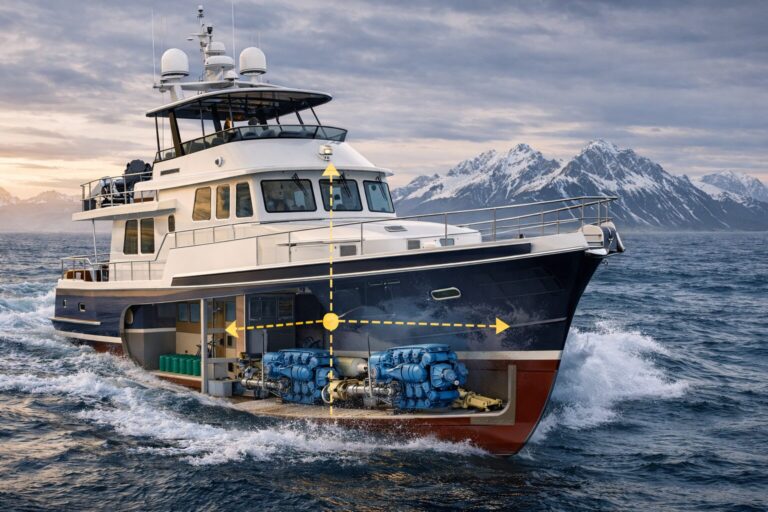
When people first see a raised pilothouse yacht, the elevated profile immediately stands out. The higher helm offers commanding visibility, protection from weather, and a sense of authority underway. But beyond appearance and comfort, a raised pilothouse has a deeper influence on how a yacht behaves on the water. One of the most important factors it affects is the yacht’s center of gravity. For trawlers and pilothouse yachts designed for long passages in demanding waters like the North Pacific, center of gravity is not an abstract engineering term. It directly influences stability, comfort, fuel efficiency, and safety. Understanding how a raised pilothouse changes this balance helps explain why proper design matters so much in serious cruising yachts.
Understanding the Center of Gravity on a Yacht
The center of gravity is the point where the yacht’s total weight is considered to act. Everything on board contributes to it. Hull structure, engines, fuel, water, equipment, furniture, and even people all play a role. If this point is low and well balanced, the yacht feels stable and predictable. If it is too high or poorly distributed, motion becomes uncomfortable and in some cases unsafe.
On a yacht, there are two main aspects of center of gravity to consider. One is vertical, meaning how high or low the weight is in the vessel. The other is longitudinal and transverse, meaning how weight is distributed from bow to stern and side to side. A raised pilothouse primarily affects the vertical center of gravity, though it can also influence fore and aft balance depending on its placement. A lower vertical center of gravity generally improves stability. It reduces rolling motion and helps the yacht return upright more easily after being pushed by waves or wind. Raising any structure above the main deck naturally lifts some weight higher, which is why the design of a raised pilothouse requires careful planning rather than simple stacking of volume.
How a Raised Pilothouse Alters Weight Distribution
A raised pilothouse adds mass above the main deck. This includes structural materials, windows, electronics, seating, and often heavier framing to support large glass areas. All of this weight is positioned higher than in a traditional flush deck or lower pilothouse configuration. As weight moves upward, the vertical center of gravity rises. This does not automatically make a yacht unstable, but it does change how the yacht reacts to motion. Rolling periods can become longer, and the initial feeling of stiffness may be reduced. In poorly designed vessels, this can lead to uncomfortable side to side motion, especially in beam seas.
However, experienced yacht builders counteract this shift by making deliberate design choices elsewhere. Heavier components such as engines, tanks, batteries, and machinery are often placed as low as possible in the hull. Hull forms are also optimized with wider beams or deeper sections to create a stronger righting moment. In custom trawlers, ballast and structural weight distribution are calculated early in the design phase to ensure the raised pilothouse does not negatively affect overall balance. When done correctly, the benefits of the raised pilothouse can be achieved without compromising stability.
Stability, Motion, and Comfort at Sea
The relationship between center of gravity and comfort becomes very clear once a yacht is underway. In calm water, most yachts feel fine regardless of configuration. It is in real sea conditions where differences appear. A higher center of gravity can increase roll amplitude if not managed properly. This means the yacht may lean further to each side as waves pass. For long distance cruising, especially in the North Pacific where swells are long and weather systems are powerful, this matters a great deal. Excessive rolling leads to crew fatigue, difficulty moving around the vessel, and strain on equipment.
A well designed raised pilothouse yacht uses hull shape and weight placement to soften motion rather than amplify it. Wider waterlines, proper displacement, and carefully calculated metacentric height all contribute to predictable behavior. Many trawler style yachts actually benefit from slightly slower, more gentle roll motions, which can feel more comfortable over long passages than quick, sharp movements. Another factor is pitch, or fore and aft motion. A raised pilothouse positioned too far forward can affect pitching in head seas. Thoughtful placement closer to the vessel’s natural center reduces this effect and improves ride comfort.
Visibility and Control Versus Structural Trade Offs
One of the biggest reasons raised pilothouses exist is visibility. From an elevated helm, the operator can see over the bow more clearly, track wave patterns, spot debris, and navigate tight passages with confidence. In rough weather, being able to look down on the sea rather than through it is a major advantage. This improved situational awareness contributes to safety and operational control, especially during long watches. It also allows the main deck and salon areas to be designed with better sightlines and more natural light.
The trade off is structural complexity. Supporting a raised pilothouse requires stronger framing and careful attention to stiffness. Large windows must be reinforced without adding unnecessary weight high up. Materials selection becomes critical. Lightweight composites, aluminum, or carefully engineered steel structures are often used to balance strength with weight control. The best designs integrate the pilothouse into the yacht’s overall structure rather than treating it as an add on. This integration helps manage the center of gravity while delivering the practical advantages that raised pilothouses are known for.
Why Proper Design Matters for North Pacific Cruising
In regions like the North Pacific, yachts must be designed with realism rather than marketing alone. Long distances, cold water, strong winds, and large swells demand vessels that behave predictably in difficult conditions. A raised pilothouse can be an asset in this environment when engineered correctly. The higher vantage point improves navigation in poor visibility. The enclosed, elevated helm offers protection from spray and cold. The separation between working spaces and living areas adds comfort during extended voyages.
But these benefits only come when the center of gravity is carefully controlled. Poorly executed raised pilothouses can lead to top heavy yachts that feel uneasy offshore. Proper hull displacement, low mounted machinery, smart structural engineering, and thorough stability analysis are essential. Custom built trawlers and pilothouse yachts allow these factors to be addressed from the beginning rather than compromised later. By designing the yacht as a complete system, the raised pilothouse becomes part of a balanced whole rather than a liability.
Final Thoughts on Balance and Purpose
A raised pilothouse changes a yacht’s center of gravity, but change does not mean compromise. It simply means responsibility. When designers and builders understand how weight, structure, and hull form interact, the raised pilothouse becomes a powerful feature rather than a risk.
For owners planning serious cruising, especially in demanding waters, the conversation should never stop at appearance or interior layout. How the yacht carries its weight, how it moves in a seaway, and how it supports the crew over long distances all begin with center of gravity. A well designed raised pilothouse yacht proves that comfort, visibility, and offshore capability can coexist when balance is treated as a priority rather than an afterthought.
We turn your cruising dreams into reality by developing bespoke trawler and pilothouse yachts built for comfort, safety, and performance. From the initial hull design to the final varnish, our experienced naval architects and craftsmen collaborate with you every step of the way, integrating fuel-efficient engines, ergonomic deck layouts, and beautifully appointed living spaces. With industry-leading warranties and personalized support, we make sure your new yacht feels like home the moment you step on deck. Reach out to us by email at info@northpacificyachts.com for personalized responses to all your inquiries. If you’d prefer a conversation, we invite you to give us a call at 1-844-922-4877.