

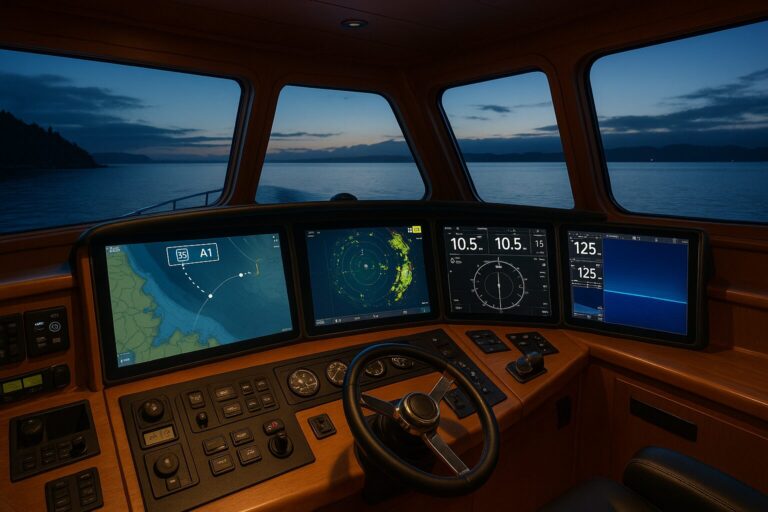
Marine electronics marketing has adopted the language of artificial intelligence with remarkable speed. Helm displays now promise smart tracking, predictive routing, and intelligent hazard identification. For a trawler owner preparing for extended coastal passages or an ocean crossing, separating functional assistance from promotional hyperbole is essential.
Modern helm software falls into distinct functional tiers. Understanding its functions, limits and dependencies helps you judge whether it adds useful information to the watch.
Dissecting the Software: Target Detection, Routing, and Control Authority
When assessing navigation systems for trawler owners, distinguish four jobs rather than treating the helm as a unified digital brain:
- Detection: A camera-based system may identify and track visually observable contacts.
- Alert prioritization: Software may organize contacts or alerts to draw attention to relevant information. Ask what inputs it uses and how it handles uncertain detections.
- Planning assistance: A tool may propose a route using chart, weather or other data. Examine its assumptions, data age and limits before accepting a suggestion.
- Control authority: Establish whether a product only presents information or can command installed steering or propulsion equipment. These are different capabilities that must be verified for the exact installation.
A product’s use of the word AI does not establish which of these functions it performs or how well it works on your vessel.
Commercial Bridge Tech vs. Trawler Realities
The Orca AI SeaPod uses visual and thermal cameras with navigation data to assist commercial bridge crews.
SeaPod is a useful commercial-system example, not evidence that the same installation fits an owner-operated trawler. Orca AI describes it as a visual and thermal navigation aid that adds context alongside required bridge systems and watchkeeping. It does not replace radar or the officer of the watch.
The manufacturer identifies weather, target size, range and temperature as performance variables. Ask how mounting, field of view and vessel motion would affect the specific installation being proposed, and whether the vendor supports that use. Avoid treating a successful demonstration aboard a large commercial vessel as proof of fit aboard a much smaller yacht.
Testing Inputs, Blind Spots, and Failure Modes
If you evaluate an auxiliary detection system for your trawler, look past the sunny sales demonstrations. Interrogate the failure modes.
- View and sensor condition: Ask about coverage, obstruction, lens contamination, poor visibility and how the operator knows when a sensor is impaired.
- Offline behavior: Establish which functions continue locally without an internet connection, which require downloads and how loss of a data source is displayed.
- Alert workload: Observe false or repeated alarms and how the system handles contacts that appear and disappear. More alerts do not automatically make a watch easier.
- Power and support: Obtain the actual consumption, mounting, cooling, maintenance and update requirements. Include those demands in the boat’s equipment budget.
Navigation Responsibility Remains in the Wheelhouse
No sensor suite, software algorithm, or commercial detection aid alters your legal status as skipper.
The USCG navigation rules apply whether you pilot a hand-steered classic tug or a glass-bridge long-range cruiser. Rules 5, 6, and 7 mandate duties that cannot be delegated to an algorithmic processor:
- Rule 5 (Lookout): Maintain a proper lookout by sight and hearing and by all available means appropriate to the circumstances.
- Rule 6 (Safe Speed): Choose speed so effective collision-avoidance action and stopping are possible in the prevailing conditions; visibility, traffic, maneuverability, wind, sea, current and equipment limitations matter.
- Rule 7 (Risk of Collision): Use all appropriate available means to assess collision risk, including proper use of operational radar. Doubt about risk must be treated as risk.
An AI detection alert provides situational context, not permission to relax your watch or uncouple your attention from the wheelhouse windows.
Practical Helm Integration on North Pacific Yachts
Our North Pacific 49′ Pilothouse equipment includes Garmin chartplotters, autopilot, radar, fish finder and VHF radios. The current list evolves, so ask for the exact equipment configuration. It also includes an AGM battery bank and Victron inverter/charger, with lithium battery options available. These facts do not establish an AI system as standard equipment or verify a particular third-party product’s compatibility.
Our equipment access provisions include hatches, removable headliners and wiring chases. For a proposed addition, ask the installer how it would be mounted, powered, serviced and isolated from other equipment if it fails.
Before buying, request a demonstration relevant to your vessel and expected conditions. Assess the display, alert workload, missed or ambiguous contacts, offline behavior and training requirements. The decision should rest on demonstrated function and support, not a promise that software can take over the watch.
For a new-yacht equipment discussion, discuss your cruising plans with us. We can consider our available configurations alongside the questions that a specialist installer or product vendor must answer.