

The asking price of a used trawler and the contract price of a new boat answer only part of the ownership question. A useful ten-year comparison includes what each boat needs before cruising, the costs of your intended use, financing costs if applicable and an uncertain future sale.
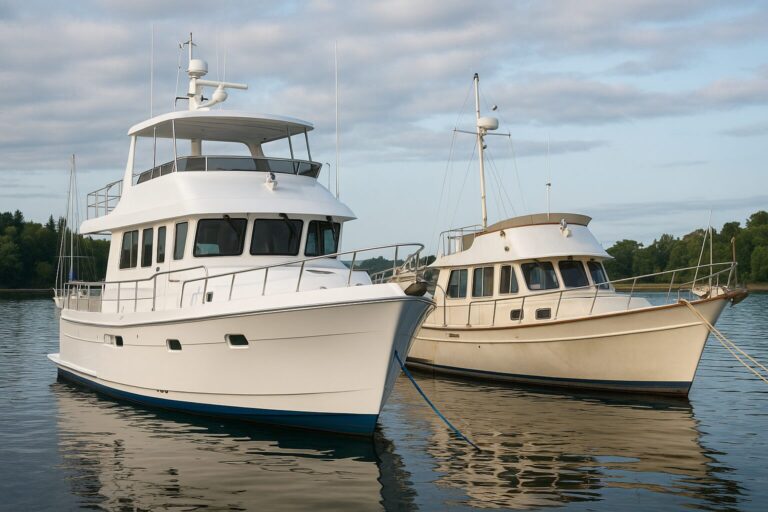
The result is a planning estimate, not a forecast or a verdict that new or used always costs less. Compare two actual candidates and make the assumptions visible.
Put Both Candidates on the Same Basis
Set the ownership period, intended cruising hours, home base and equipment you consider necessary. Use your own plans rather than a supposed typical owner’s hours. A boat needing different moorage, transport or initial work may produce a different result even when its purchase price is lower.
Record what is included in each offer. Use the specifications and equipment list for our 49 Pilothouse to start that conversation. Confirm the particulars of the quote or the used yacht rather than assume that the current list describes every vessel.
A fair comparison does not require identical boats. It requires explaining their differences and including the costs you expect to incur to make each suitable for the same use.
Build the Acquisition and Operating Ledger
Costs to Get Ready to Cruise
Include the purchase price, transaction costs that apply to your situation, delivery or transport, and commissioning or immediate work not already included. Obtain current quotes and check the applicable tax, registration and documentation requirements for the location and transaction.
For a used candidate, inspection findings can identify work to price. For a new candidate, clarify included commissioning and equipment. Avoid counting a service twice because it appears in both a purchase package and a separate quote.
Recurring Costs and Major Work
List moorage, insurance, routine care, fuel and other operating expenses using the intended location and use. The Costs of Yacht Maintenance: Budgeting for Long-Term Care helps organize maintenance questions.
Add possible replacements or major repairs separately. Manuals, service history, condition findings and supplier quotes are more useful than assuming that every battery, enclosure or engine reaches a fixed replacement age. Mark costs and timing as estimates when they are not established.
A current annual quote is a starting point for future years, not a commitment that the rate will remain unchanged. Show how you extend or adjust it and keep that assumption separate from the verified quote.
Handle Resale and Financing Without Double Counting
For a simple undiscounted comparison, use this identity:
Ten-year net ownership cost = purchase and transaction costs + make-ready work + operating and repair costs + borrowing interest and fees − net sale proceeds.
Here, net sale proceeds means the assumed selling price less selling expenses, before repaying any remaining purchase loan. Purchase price already counts the asset cost. Do not add loan principal repayments again, and do not subtract depreciation separately when purchase price and net sale proceeds already account for the change in value.
Cash flow is a different question. A financed buyer needs a schedule of the deposit or down payment, loan proceeds, payments, operating expenses and any outstanding balance due at sale. Do not mix that cash-flow schedule into the purchase-price identity. Loan principal is not guaranteed to be recovered at resale.
This simple comparison does not calculate investment returns, the time value of money or personal tax effects. If those matter to the decision, have them assessed using your circumstances and the actual financing terms.
Use a Transparent Two-Boat Ledger
| Input | New candidate | Used candidate | Evidence or assumption |
|---|---|---|---|
| Purchase and transaction costs | Offer, quote and applicable charges | ||
| Delivery and make-ready work | Included items and separate estimates | ||
| Moorage and insurance by year | Current quotes; future assumptions identified | ||
| Fuel and routine care by year | Intended use, equipment guidance and local quotes | ||
| Major work and contingency | Condition findings and owner-selected allowances | ||
| Interest and borrowing fees | Actual lender terms and schedule | ||
| Assumed sale price | Scenario assumption; not a guaranteed value | ||
| Selling expenses | Estimated sale-related costs | ||
| Net ownership estimate | Consistent arithmetic across both candidates |
Keep every entry traceable. An unknown should be labeled unknown, rather than replaced with a number that makes the preferred boat look affordable.
Test the Uncertain Assumptions
Run an owner-selected base case and alternatives with higher repair costs or lower sale proceeds. Change one assumption at a time first, so you can see which inputs drive the decision. Then consider a combination of adverse assumptions to assess the funds you might need.
Do not present these scenarios as probable market outcomes without evidence. They are tools for asking whether the decision remains workable if an estimate proves wrong. If the apparent saving depends entirely on an optimistic sale price or omitted repairs, gather more evidence before relying on it.
Collect the Quotes and Records Before Choosing
A buyer-commissioned marine survey helps establish condition and identify questions for further investigation. Agree the scope, haulout and any machinery specialist work. It does not predict every future repair.
Review service records, invoices and written warranty terms where applicable. Clarify what is covered, excluded or transferable rather than assume that a new boat brings years of cost-free ownership or that a used boat cannot be reliable.
Bring your candidate comparison and unresolved inputs when you Plan Your Yacht. A useful decision combines a boat you want to use with costs and uncertainties you understand.