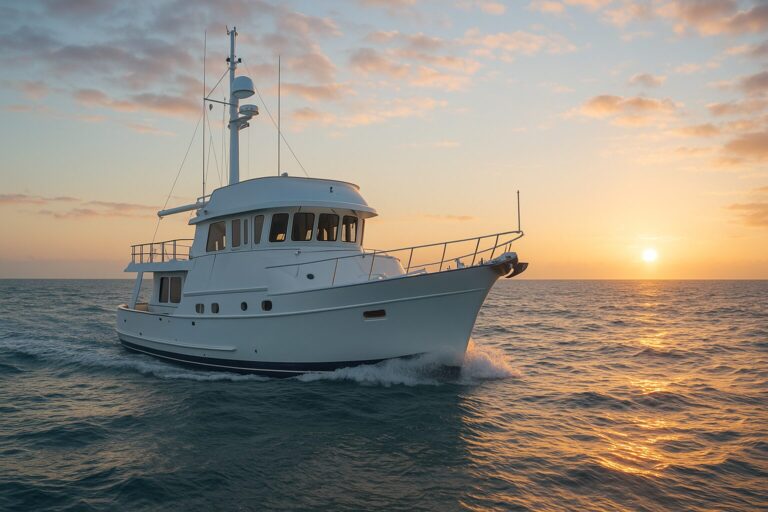
Crossing an ocean is a milestone in any boater’s life, and for owners of trawlers, the idea of making such a passage can be both exciting and daunting. See Can Trawlers Cross Oceans?. These vessels, with their signature displacement hulls, impressive fuel economy, and home-like accommodations, are favored for long-range cruising, particularly along coasts and through protected waters. However, a transoceanic voyage is an entirely different challenge. It tests not only the vessel’s structural and mechanical capabilities but also the crew’s skill, preparedness, and endurance. While many trawlers are theoretically capable of handling blue-water conditions, safety and success depend on a broad spectrum of factors, from design and maintenance to weather strategy and human resilience. The question isn’t simply whether a trawler can cross an ocean, it’s whether you and your boat are truly prepared for what that journey entails.
Hull Design and Stability
A trawler’s hull design plays a central role in determining its offshore performance. Most trawlers feature a full-displacement or semi-displacement hull, which offers very different handling characteristics than the planing hulls found on faster boats. Displacement hulls remain in the water at all speeds, slicing through the sea rather than riding over it, which leads to a more stable and predictable motion, particularly important during long stretches at sea. These hulls are inherently more efficient at lower speeds, making them ideal for extended cruising where fuel conservation and comfort take precedence over speed. The deep draft and rounded bilge help the vessel track steadily, reducing the lateral motion that causes fatigue.
That said, not all displacement hulls behave the same way. Some trawlers may experience more yaw or leeway in crosswinds or following seas, especially those with higher superstructures or shallow skegs. Many ocean-going models address this with stabilizing features such as deep skegs, keel extensions, or even active fin stabilizers and gyros. These technologies can significantly improve comfort, especially during beam seas, but they require power and must be maintained carefully. For sailors transitioning from sailboats, the steadiness of a well-ballasted trawler might feel like cruising in a floating cottage.
Reliable Systems and Redundancy
Long-distance offshore passages leave no room for unreliable systems. A trawler planning to cross an ocean must be equipped not only with durable mechanical and electrical systems but also with multiple layers of redundancy. At the heart of the vessel’s reliability is its engine, most commonly a slow-turning, naturally aspirated diesel. These engines are known for their endurance and simplicity, and when properly maintained, they can operate for thousands of hours without major service. However, reliability isn’t just about having a strong engine; it’s about having the spares, tools, and knowledge to diagnose and fix problems at sea. Filters, impellers, belts, oil, and coolant should all be stocked in abundance, and the crew should be capable of performing routine repairs. In twin-engine trawlers, separate fuel systems and watertight compartments provide a level of fail-safe redundancy that can be a lifesaver in the event of flooding or fire.
Electricity is another critical component that demands careful planning. Navigation electronics, communication devices, lighting, and refrigeration all require a reliable power supply. A smart trawler setup includes multiple charging sources, engine alternators, inverter/chargers, solar panels, and possibly wind or hydro generators. Battery banks must be sized for multi-day operation, and key electronics such as radar, AIS, and GPS should have battery-backed or handheld alternatives. Unlike a sailboat, which can limp along without power if needed, a trawler’s systems are often interdependent and electrically driv
Weather Planning and Route Selection
Unlike fast yachts or commercial ships that can outrun incoming systems, trawlers demand a far more cautious and calculated approach to ocean voyaging. Their slower speeds—typically 6 to 8 knots under power mean they spend more time at sea and are more exposed to changing weather conditions. As a result, the timing of departure is crucial. Monitoring weather windows, identifying patterns, and understanding ocean currents are as important as checking fuel levels or provisioning. Fortunately, modern trawler captains have access to advanced forecasting tools, including satellite weather, GRIB files, weatherfax broadcasts, and routing software.
Equally important is the route itself. Smart trawler navigators often favor “island-hopping” strategies over direct crossings. By using stepping-stone routes—such as transiting via the Azores or the Aleutians, sailors gain options for refuge and resupply while reducing the psychological toll of uninterrupted open water. While this adds distance and complexity, it reduces risk. The ability to pull into a sheltered harbor during an approaching low can be the difference between a safe detour and a disaster. Open-ocean routing also involves factoring in fuel range, currents like the Gulf Stream or the Equatorial Counter Current, and the prevalence of shipping traffic or debris.
Crew Experience and Watchkeeping
Even the most seaworthy trawler is only as capable as the crew operating it. Ocean crossings require more than enthusiasm, they demand discipline, preparedness, and the ability to perform under pressure. Every crew member should be familiar with the vessel’s systems and be trained in basic seamanship, navigation, and emergency procedures. Formal training courses in radar use, marine weather interpretation, first aid, and damage control are invaluable and may well save lives. Watchkeeping is particularly critical on long passages, where fatigue and complacency are among the greatest dangers. A structured watch system—often four hours on, eight hours off is designed to ensure that each person gets adequate rest while maintaining constant vigilance.
Each watch should ideally include two people: one responsible for helming or autopilot monitoring, and another keeping lookout for traffic, floating debris, and changing sea conditions. Communication between watches is vital. Changes in weather, system status, or even the behavior of a nearby vessel should be documented and passed on. Regular drills for man-overboard scenarios, engine room fires, and abandon-ship situations help transform panic into a practiced response. It’s also worth remembering that morale matters. Life at sea can be monotonous or stressful, depending on how the crew handles the routine.
Safety Gear and Emergency Preparedness
Offshore safety hinges on both preparation and the quality of equipment onboard. It’s one thing to have the right gear; it’s another to know how and when to use it. Each crew member should have a properly fitted life jacket with a harness and tether, particularly for night watches or rough-weather deck work. Jacklines should be rigged fore and aft to allow safe movement around the deck. An EPIRB (Emergency Position Indicating Radio Beacon) is mandatory on ocean crossings, ideally registered and tested before departure. Additionally, two-way satellite communication devices like a SEND (Satellite Emergency Notification Device) provide both SOS signaling and the ability to send and receive text updates a lifeline for updates, check-ins, or coordination with rescue services.
A well-equipped trawler will also carry a properly rated life raft with capacity for all crew, an abandon-ship grab bag with essentials like water, rations, flares, thermal blankets, and a handheld VHF radio. Immersion suits or anti-exposure gear are highly recommended, especially when crossing cold waters. Fire extinguishers, smoke and CO detectors, high-capacity bilge pumps, and portable pumps should all be installed and regularly tested. It’s not enough to buy the gear; maintaining it is equally crucial. Flares expire, hydrostatic releases fail, and EPIRB batteries degrade.
Limitations and Considerations
Despite their many strengths, trawlers are not immune to the realities of the ocean. Their slower cruising speed not only increases the duration of each passage but also exposes the vessel and crew to longer periods of potentially adverse conditions. Sea sickness, fatigue, and mental strain can build over time, particularly on less experienced crews. While trawlers are often admired for their spacious interiors, those same features can pose challenges offshore. For example, large open spaces can become hazardous in a seaway, where unsecured items may shift or injure crew. Galley layouts that work fine at anchor may require significant adaptation underway, especially in beam seas or pitching conditions.
Fuel capacity is another practical limitation. While trawlers are generally fuel-efficient, offshore routes require careful planning with generous safety margins. Fuel consumption rises in rough seas, and miscalculations can be costly. External fuel bladders, transfer pumps, and accurate fuel-flow monitoring systems are recommended for transoceanic passages. Drifting, yawing, or sluggish maneuvering in strong crosswinds may also present navigational challenges, particularly for high-windage vessels. Ultimately, a successful ocean passage in a trawler is a blend of strengths and compromises—an experience defined not by speed or simplicity but by preparation, patience, and persistence.
Why Choose North Pacific Yachts Services
We turn your cruising dreams into reality by developing bespoke trawler and pilothouse yachts built for comfort, safety, and performance. From the initial hull design to the final varnish, our experienced naval architects and craftsmen collaborate with you every step of the way, integrating fuel-efficient engines, ergonomic deck layouts, and beautifully appointed living spaces. With industry-leading warranties and personalized support, we make sure your new yacht feels like home the moment you step on deck. Reach out to us by email at info@northpacificyachts.com for personalized responses to all your inquiries. If you’d prefer a conversation, we invite you to give us a call at 1-877-564-9989.
To continue researching long-range operating topics, visit the trawler archive for related articles.